

March 2017 Volume II Issue III
|
Marcia Baldanza, the author of Professional Practices and a Just ASK Senior Consultant, lives in Arlington, Virginia, and Ft. Lauderdale, Florida. She recently retired from the School District of Palm Beach County, Florida, where she was an Area Director for School Reform and Accountability; prior to that she was Director of Federal and State Programs. |

Making PSEL Come Alive!
Equity and Cultural Responsiveness
This issue of Professional Practices digs more deeply into Professional Standards for Educational Leaders (PSEL) Standard 3: Equity and Cultural Responsiveness. I examine student performance data with a moral imperative; dive into equality versus equity; propose theories of action for equity in schools; and plan an interview to match school cultural needs.
I believe that we are ethically and morally bound to provide all students with an education that enables them to be college or career ready at graduation and, further, I believe that works begins with Pre-K. I strongly believe that we must compel ourselves and our colleagues to act with a moral conscience to understand our students and their families in order to help them achieve great things.
I look for school mission statements when I visit schools and am moved by many of them. Some that resonate with me are:
- Our mission is to provide a nurturing learning environment in which students are challenged to reach their academic potential through a standards-based, rigorous curriculum. We are dedicated to developing and supporting each child”™s unique talents within an atmosphere of cooperation and respect for individual differences. Our focus is on the whole child. The Sunshine School is committed to instilling in each student a desire to learn, to take appropriate risks, to solve problems and to accept challenges. Teaching the values of good citizenship is integrated into all areas of school life. By working collaboratively as a team that includes teachers, parents, staff and administrators, we best prepare our students to be independent thinkers, lifelong learners and responsible citizens who will be active and compassionate participants in our society. (New York City)
- Orange Grove students and staff will show integrity, provide service to others before self, and demonstrate excellence in the areas of academics and citizenship. (Texas)
- We are committed to providing a world-class education by fostering an environment where students are challenged through rigorous coursework that will prepare them for college or career and empower each student to reach his or her highest potential. (Florida)
- The School of Lake View will implement personalized educational programs to facilitate student achievement. These educational programs will demonstrate that standards-based educational reform can provide a prototype for changing the way teachers teach and students learn. (California)
- Challenge students intellectually; inspire their confidence, curiosity, and creativity; and prepare them to thrive in a diverse and complex world by ensuring that they are independent learners, effective communicators, community-minded citizens, and balanced individuals. (Virginia)
Place your own school mission beside these exemplars. Each one, including your own, has compelling language that could ideally drive staff and students to new heights, right? But what happens when these words don”™t lead to real action? What happens when “all” really means “some?”
- What happens when you are having a data chat with a teacher and when asked to explain the performance of a student, the teacher responds, “Well, that”™s a good score for her.” Does “all” mean “all” or does “all” mean “some?”
- What happens when the teacher says that “this is my low group” and so has different expectations for them. Does “each student” mean “all” or “some?”
- What happens when we celebrate that 70% of a class or school met proficiency? Doesn”™t that mean that 30% did not meet proficiency? Yikes! What about that 30% in that mission with the words “all” and “each” embedded? Would you ever write a mission to contain the words, “”¦except for the students who are second language learners, have special needs, are homeless, or gifted.” Of course, you wouldn”™t!
PSEL sets forward ambitious and high standards for educational leaders and the actions to achieve them. It isn”™t enough to close the achievement or engagement gap; it must be eliminated and replaced with all students reaching high standards and beyond. Culturally responsive teaching and learning environments go a long way towards eliminating the gaps. A curriculum that is rigorous and relevant helps students connect. Data-driven instructional practices that provide academic press and support is imperative. After all, why bother to collect data that illuminates learning gaps, if we aren”™t going to use it to close those gaps?
My husband is teaching an advanced college level economics class. He isn”™t a teacher by training and I have enjoyed helping him plan with the end in mind and including active learning strategies for each three-hour evening class. Last week, he gave a mid-term exam that we wrote together. I helped him score them and when we were finished, we talked about the fact that the highest grade was 76%. His first question was, “How could they do so poorly? I covered each question on the test and supported them with readings.” I reminded him that because it was covered, doesn”™t mean it was learned. We need to reframe the question we ask when students fail from, “Why are students failing?” to “How are the learning experiences we are providing failing our students?” Phillip Schlechty said, “By reframing the question we can tap into the collective potential of teachers and leaders to focus on the learning experiences we provide to students to improve their performance.” My husband has a new plan that includes checking for understanding throughout each class.
Professional Standards for Educational Leaders (PSEL)
- Mission, Vision, and Core Values
- Ethics and Professional Norms
- Equity and Cultural Responsiveness
- Curriculum, Instruction, and Assessment
- Community of Care and Support for Students
- Professional Capacity of School Personnel
- Professional Community for Teachers and Staff
- Meaningful Engagement of Families and Community
- Operations and Management
- School Improvement

Do You Have What it Takes?
This is where I am called by Michael Fullan”™s Moral Imperative of School Leadership. This two-minute video will remind you of your moral imperative as an educational leader https://michaelfullan.ca/topic-video-10-the-moral-imperative-realized/ . Today”™s educational leaders must have a strong moral purpose if they are to truly carry out their duties with conviction. Fullan suggests that “moral purpose means acting with the intention of making a positive difference in the lives of others.” This is at the very heart of school leadership in the 21st century. Understanding PSEL Standard 3: Equity and Cultural Responsiveness requires that educational leaders act with moral purpose and deliberate intention to make a difference. I believe it is an act of moral neglect to know that a student isn”™t learning and not take action. That behavior widens the equity and ultimately the achievement gap among and between students and is not acceptable!
Understanding what equity is and is not is a useful starting point. The diagram below helps us distinguish the two terms.
Equality is giving each child the same chance.
Equity is giving all children what they need to reach the goal.
 Source: https://60millionsdefilles.org/en/equityineducation
In thinking about the application of this diagram to the work of an educational leader, I propose four Theories of Action for Equity of Opportunity.
Baldanza”™s Theories of Action for Equity of Opportunity
- If states and districts reconsider how funds are allocated to schools by examining each student”™s learning gap and portioning funds differently to close that gap, equity of opportunity can be achieved.
- If districts and principals reconsider how teachers are assigned to classrooms and ensure that every student has access to a highly qualified and skilled teacher, while providing strategies to close the learning gap, equity of opportunity can be achieved.
- If principals monitor teaching practice in serious and visible ways, then teachers will teach rigorous content to all learners in differentiated ways while maintaining the same standard of excellence for all, the learning gap can be eliminated and equity of opportunity can be achieved.
- If teachers commit to using formative assessment data to re-direct energy, time, and materials towards those students not reaching standards of mastery, equity of opportunity can be achieved.
Jim Collins writes, “Good to great comes by a cumulative process-step by step, action by action, decision by decision, turn upon turn of the flywheel-that adds up to sustained and spectacular results”¦.It is a quiet, deliberate process of figuring out what needs to be done to create the best future results and then taking those steps one way or the other.” Look back to the diagram and ask yourself if all of the apple pickers (students) are getting what they need? Imagine another image that has three-high boxes for all of the people (students) to stand on. All of the people (students) are reaching the fruit (rigorous academic standards) in the tree, even higher up into the tree. Now, that”™s a vision”¦all students reaching high standards and getting what they need to meet and exceed the minimum!
Parachute Teachers
If you have a teacher out for the day,
why not bring in a scientist or musician instead of a worksheet?
—Parachute Teachers
Access articles from The Atlantic and from the Smithsonian Magazine for information about the Parachute Teachers start-up.
Parachute Teachers is a new option for two schools in Boston Public Schools and one that I bet will spread. Parachute, founded by Sarah Cherry Rice who is a Teach for America alum and a doctoral student at Harvard, finds prospective substitutes, handles background checks, and offers basic training. Once they are vetted and trained, Parachute Teachers highlight an area they would like to teach and are requested and assigned as needed. The substitutes provide students with an opportunity to experience things they have never experienced or, perhaps, even discussed. This fledgling concept seems like a win for everyone involved, especially for short-term needs. Teachers don”™t have to prep for a substitute while they participate in professional learning and students learn something new from a community member.
”ƒ
If you are not ready to take on this cutting-edge initiative, think about scheduling a few field trips, chaperoned by parents; such outings could give teachers time to learn together while the students are off learning outside the school. Another great idea is whole school assemblies or in-house field trips with community members providing expertise and hands-on exhibits. Having a visiting museum docent, excerpts from a play, or an orchestra performance can give teachers needed time for collaborative data analysis, planning, and learning while exposing students to the world of arts and sciences with concrete examples of life beyond the classroom rather than always relying on print or digital representations.
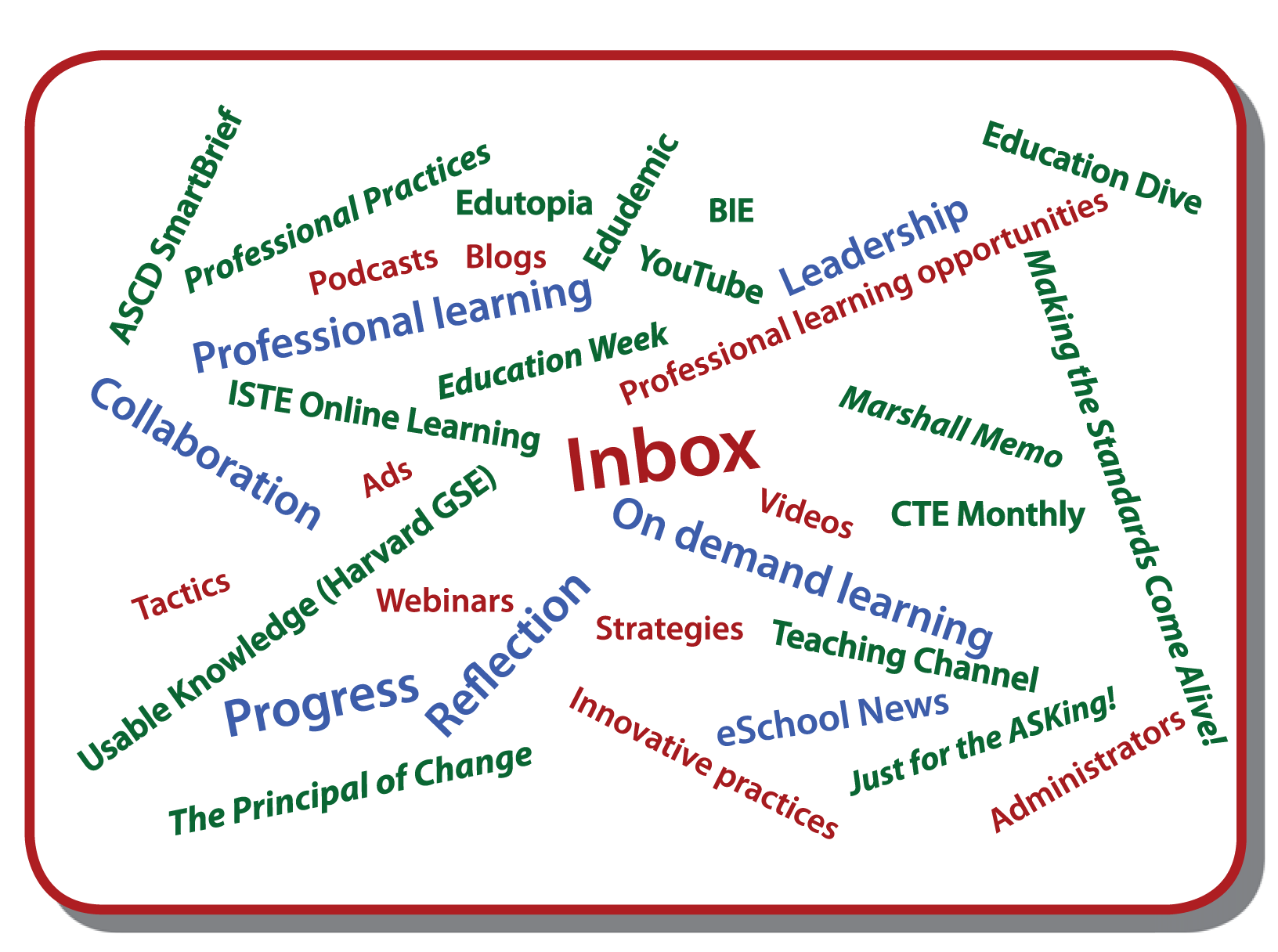
What’s in Your Inbox
Using technology in support and service of learning is embedded in PSEL Standard IV: Curriculum, Instruction, and Assessment. Education leaders can learn about effective practices around the world by thoughtfully examining what others are doing. Advances in technologies and digital tools allow us to learn from others in our own time and space as deeply as we want or need. Carefully selecting a personal learning network to include ideas from others can open new ideas and validate others.
Some time ago I read an article by Pamela DeLoatch that was a review of blogs for education administrators. I couldn”™t wait to get all of her recommendations delivered to my email for me to read at my convenience! If you”™re anything like me, I sign up for all sorts of professional subscriptions, emails, blogs, and newsletters. Then, before I know it, I am unsubscribing because I can”™t keep up with them all or they didn”™t turn out to be what I was looking for. So, after a few months, I narrowed my list. In each issue, I will share a blog that I regularly open and actually read.
Featured Blog
The Principal of Change
by George Couros
https://georgecouros.ca/blog/
Couros is a Canadian educational leader, blogger, author, and learner. He delivers his thoughts on how to promote successful school leadership in blogs, TEDx, his book The Innovator”™s Mindset, and stories. In his blog, Couros shares a professional learning event to which he invited students to come observe and then give him feedback. What they said will surprise you!
I believe we have a moral imperative to improve outcomes for our students and much of our new learning as teachers comes through collaborative job-embedded opportunities with each other. Integrating new learning into existing practice is a required extension. Asking our ultimate customer, the student, for feedback on the result versus the intent can be a powerful method for improvement. Check this out and consider inviting your students to a professional learning experience. https://georgecouros.ca/blog/archives/7053.
Problems of Practice: Ethics and Professional Norms
The Facilitator”™s Guide published by Connecticut”™s Education and Mentoring Program for the study of Ethical and Professional Dilemmas for Educators was created to help educators understand the Code of Professional Responsibility for Educators. It supports PSEL Standard II: Ethics and Professional Norms, and It is easy to use and is a great resource for professional learning. It presents 12 real-life dilemmas similar to ones we have faced including transporting students, contact with students, the use of social networks, teacher public behavior, student confidentiality, bullying, and more. The process recommended in the guide includes presentation of a dilemma, the Connecticut context, and processing questions complete with possible answers. The 48 page guide is available at www.ctteam.org/df/resources/Module5_Manual.pdf.
To jump start your thinking about possible dilemmas you might encounter, I am listing four below. Two focus on teacher issues and two on issues related to principal situations.
- Mr. T is a long-time teacher at Sunshine MS and has run a sports camp during extended breaks from school and during the summer months for years. The camp takes place at the school and uses the school facilities and equipment. Parents and students like the camp and the enrollment has grown each year. The fee charged is paid to Mr. T Camps.
- Ms. P is a new teacher and has a student who is chronically late for school, missing the bus 3-4 days a week. Ms. P notices that she and the student live in the same neighborhood. Ms. P offers to pick up the student on the way in each morning.
- Dr. F is a veteran principal and has enjoyed a successful 30 years in the same school district. Recently the district adopted a new literacy model that is the product of curriculum mapping and team planning. He collects the materials, lessons, assessments, and plans. He puts them into a binder and solicits interest from publishers. A publisher expresses interest and offers to pay Dr. F for the binder.
- Bright Elementary is going through a furniture upgrade, which all schools have every 10 years. This includes office and classroom furniture. The old furniture is scheduled to be moved to the warehouse for later disposal. The principal is part of a family business and takes the old office furniture to the business.
Connecticut”™s guide recommends the following processing questions:
- What possible issues or concerns might this scenario raise?
- How could this situation become a violation of the code of conduct or other school/district policies?
- In this situation, what are some potential negative consequences for the teacher (principal), the students, and the school community?
- What responses/actions will result in a more positive outcome and/or what proactive measures might be considered?
In all cases, facilitators of these discussions should use local code and policy to get the most benefit from this activity. I suggest pulling out your own state or district codes of ethical conduct to increase relevancy.
Professional Standards for Educational Leaders (PSEL) Update
According to Denisa Superville in her January 24th Education Week, Northwest Missouri State University has redesigned its master”™s program in education leadership around PSEL. Aspiring principals engage in rigorous and relevant preparation and pre-job experience that professional standards now demands. Superville also notes that Delaware, West Virginia, and Nebraska are using the PSEL standards “”¦ to revamp how they are preparing and supporting their next generation of principals and school leaders.” I am certain that more states will follow this lead. Stay tuned”¦
Resources and Refrences
Couros, George. The Prinicpal of Change. Access at https://georgecouros.ca/blog/.
DeLoatch, Pamela. “20 Education Administrator Blogs.”Edudemic. May 11, 2915. Access at www.edudemic.com/admin-blogs/.
National Policy Board for Educational Administration. Professional Standards for Educational Leaders 2015. Reston, VA, 2015. Access at www.ccsso.org/Documents/2015/ProfessionalStandardsforEducationalLeaders2015forNPBEAFINAL.pdf.
Rutherford, Paula, et al. Creating a Culture for Learning: Your Guide to PLCs and More. Alexandria, VA: Just ASK Publications, 2011.
Superville, Denisa. “New Principal Standards Catch On.” Education Week. January 24, 2017. Access at www.edweek.org/ew/articles/2017/01/25/new-principal-standards-catch-on.html.
Connecticut Teacher Education and Mentoring Program Facilitator”™s Guide for Ethical and Professional Dilemmas for Educators. Access at www.ctteam.org/df/resources/Module5_Manual.pdf.
The Council of Chief State School Officers & The Collaboration for Effective Educator Development, Accountability, and Reform Center. PSEL 2015 and Promoting Principal Leadership for the Success of Students with Disabilities. Access at www.ccsso.org/Documents/2017/PSELforSWDs01252017.pdf.
Permission is granted for reprinting and distribution of this newsletter for non-commercial use only.
Please include the following citation on all copies:
Baldanza, Marcia. “Learning for All Students, All Staff, and Yourself.” Professional Practices. February 2017. Reproduced with permission of Just ASK Publications & Professional Development (Just ASK). © 2017 by Just ASK. All rights reserved.